How to Win FreeCell Solitaire: Mathematics, Column Mobility, and the 99.9% Solvable Puzzle
Most solitaire games test your patience against blind luck. You flip cards from a hidden stockpile, pray for matching suits, and lose games simply because the cards were stacked against you. Klondike traps you behind face-down barriers. Spider buries you under chaotic suits.
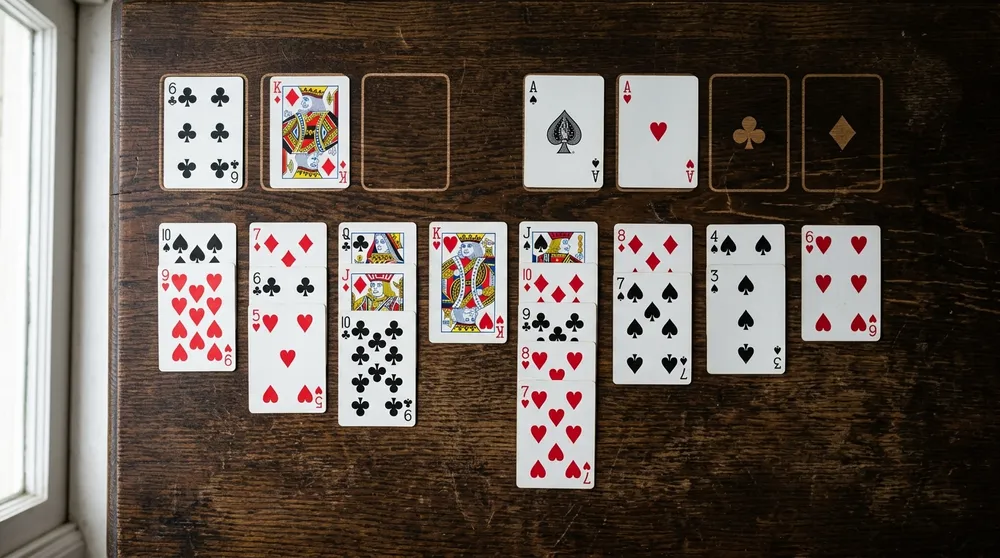
FreeCell does not rely on chance. Every single card of the 52-card deck is dealt face up across eight tableau columns right from the opening second. There is no hidden stockpile. There are no concealed cards. There is zero hidden information.
Because all cards are visible, FreeCell is not a game of chance. It is a deterministic combinatorial puzzle comparable to chess or peg solitaire. Computer solvers and mathematical analyses have established that at least 99.99 percent of all possible random deals can be won. When you lose a game of FreeCell, you did not get unlucky. You made a bad move.
Mastering this game requires abandoning casual clicking. You need an exact understanding of column movement formulas, careful reserve cell discipline, and calculated foundation timing. You can test these mechanics immediately without installation by playing FreeCell Solitaire on Unicorn Games directly in your browser.
The Mathematical Origin and Solvability of FreeCell
Paul Alfille created FreeCell in 1978 on the PLATO computer system at the University of Illinois. Alfille modified an older solitaire variation called Baker's Game, invented by mathematician C. L. Baker. In Baker's Game, tableau cascades had to be built down by suit, which resulted in a brutal win rate below 30 percent. Alfille changed a single rule: build down by alternating red and black suits.
That single modification unlocked mathematical perfection. In 1991, Jim Horne programmed FreeCell for the Microsoft Entertainment Pack for Windows, seeding 32,000 numbered deals using a simple 16-bit pseudo-random number generator.
As millions of players received Windows computers, those 32,000 hands became a global benchmark. In 1994, Dave Ring organized the Internet FreeCell Project to attempt human solutions for every single deal. Volunteers tackled all 32,000 deals. They solved 31,999 of them. Only deal #11982 resisted every attempt.
Years later, automated software solvers evaluated millions of random permutations. Mathematicians Don Woods, Danny A. Jones, and Gary Campbell pushed the analysis beyond 100,000,000 deals. The conclusion holds firm: out of every 100,000 random deals, approximately eight are unsolvable. The overall solvability rate stands at roughly 99.998 percent. Unless you deliberately load deal #11982, the deal in front of you can almost certainly be solved.
The Supermove Formula: Calculating Your True Movement Limit
Novice players think they can only move one card at a time in FreeCell. When they see a column of five cards, they believe it is impossible to shift. Modern digital FreeCell interfaces allow moving entire sequences with a single drag-and-drop. This convenience causes fatal confusion because the game engine only allows moving a sequence if you have enough open spaces to execute the move card by card.
This calculated threshold is called the Supermove limit. The mathematical formula governing the maximum number of cards you can move simultaneously between tableau columns is:
$$M = (1 + F) \times 2^C$$
Where:
| Empty Free Cells ($F$) | Empty Columns ($C=0$) | Empty Columns ($C=1$) | Empty Columns ($C=2$) | Empty Columns ($C=3$) |
|---|---|---|---|---|
| 0 | 1 card | 2 cards | 4 cards | 8 cards |
| 1 | 2 cards | 4 cards | 8 cards | 16 cards |
| 2 | 3 cards | 6 cards | 12 cards | 24 cards |
| 3 | 4 cards | 8 cards | 16 cards | 32 cards |
| 4 | 5 cards | 10 cards | 20 cards | 40 cards |
Look at the table carefully. Notice how empty tableau columns provide exponential growth, while free cells only provide linear growth.
With zero empty columns and four open free cells, you can only move five cards. If you open a single empty tableau column while retaining those four free cells, your moving capacity doubles to ten cards. Two empty columns lift that limit to twenty cards.
Understanding this formula changes how you look at the board. Filling your free cells paralyzes your moving engine. Clearing an entire tableau column hands you overwhelming tactical control.
Free Cells Are Emergency Air Tanks, Not Garages
The four free cells in the top left corner are temporary transfer conduits. They are not permanent parking lots for annoying cards.

When you put a card into a free cell, you pay a steep fee: you reduce your Supermove capacity. If you park three cards in the free cells, $F$ drops to 1. With zero empty columns, you can now only move two cards at a time. The game grid freezes. You can no longer transfer long runs to uncover buried pieces.
Follow these rules for managing reserve cells:
1. Keep at least two free cells open at all times. A board with two open cells retains enough elasticity to execute tactical swaps.
2. Park a card in a free cell only if that action immediately unblocks an Ace, a Two, or completes an alternating cascade on the tableau.
3. Every card parked in a free cell must have an explicit exit strategy within two moves. If you put a Black Seven in a free cell without a Red Eight available to take it, that Seven becomes dead weight.
4. Never put Kings into free cells unless it is the final card needed to clear an entire column. A King in a free cell cannot be cleared to the foundations until late in the match, and cannot be stacked onto any tableau card. It occupies that cell until the endgame.
Empty Tableau Columns: The Multiplier of Victory
An empty tableau column is vastly superior to an empty free cell.
A free cell holds exactly one card. An empty tableau column can hold an entire alternating sequence of up to $M$ cards, beginning with any rank from King down to Two.
More importantly, an empty column acts as a doubling multiplier for your entire reserve capacity. In the Supermove formula, every empty column multiplies $(1 + F)$ by a factor of 2.
When you identify a short column at the start of a match (columns 5, 6, 7, and 8 begin with six cards, while columns 1, 2, 3, and 4 begin with seven), examine whether you can clear those six cards into other tableau piles. Sacrificing two free cells temporarily to empty a column is almost always correct. Once that column is empty, your maneuvering capacity doubles, allowing you to quickly drain the free cells you just occupied.
Do not fill an empty column with a random high card unless that card has a descending chain ready to sit beneath it. Leaving a column completely empty gives you the freedom to move large card cascades back and forth at will.
The Opening Scan: What to Look For Before Making Move One
Amateur players begin clicking as soon as the deal renders. They see a Red Nine, see a Black Ten, and combine them instantly. This careless habit loses games within sixty seconds.
Before touching a single card, spend thirty seconds surveying the initial board state:

Step 1: Locate all four Aces and Twos.
The foundations require Aces first, followed by Twos. If the Ace of Spades is sitting at the very bottom of column two, you can advance it on turn one. But if the Ace of Hearts is buried under six cards in column three, that column becomes your top recovery priority. Identify how many cards block each low rank.
Step 2: Inspect suit parity and column distribution.
Check if low cards are trapped underneath their own higher cards. If a Five of Clubs sits directly beneath an Eight of Clubs in the same column, you cannot simply merge them into a single cascade. You will have to relocate the higher card to a different column before the lower card can reach the foundation.
Step 3: Spot the shallowest columns.
Identify which of the eight columns requires the fewest moves to empty completely. Clearing one column early guarantees structural dominance over the rest of the layout.
Step 4: Count safe moves before entering free cells.
Verify how many cards can be relocated between tableau columns without using a single free cell. If you can build three clean cascades on the board without touching the reserve slots, do so before parking anything in the upper left.
The Foundation Trap: Safe Auto-Play vs. Premature Clearing
Most digital versions of FreeCell include an auto-play feature that automatically flies cards to the foundation piles. This feature can destroy a winning position if you do not understand the danger.
Once a card enters the foundation pile, it cannot return to the tableau under standard rules. If you send a Three of Hearts to the foundation too early, you lose that card as a potential resting spot for a Black Two on your tableau. If you need to clear that Black Two to uncover an Ace buried behind it, you now have nowhere to put it except a precious free cell.
Follow the foundational safety rule established by professional solvers:
A card of rank $R$ is completely safe to send to the foundation if and only if:
Apply this formula:
If a game interface tries to auto-play a Three or Four before the opposite color foundation has caught up, hold it back if your game settings allow manual foundation moves. Keeping low cards in the tableau provides landing spots for small sequences.
Tactical Retreat and Reversing Column Chains
FreeCell games frequently hit a wall midway through the solution. The player has built several descending columns, but the remaining cards do not match. Three free cells are full. No empty columns remain.
When this happens, do not restart the match. Execute a deliberate tactical retreat.
A tactical retreat involves breaking apart an existing tableau cascade to liberate a specific key card. Suppose you have a clean cascade: Black Jack, Red Ten, Black Nine, Red Eight. You desperately need a free cell to uncover the Two of Diamonds, but all cells are occupied.
Look at the cards in your free cells. If one of them is a Black Queen, you can shift the Jack-Ten-Nine-Eight chain underneath that Queen. That clears the original column entirely.
If no Queen is available, you can temporarily disassemble the chain by placing the Eight and Nine into alternate columns or free cells, extracting the card underneath, and reassembling the sequence later. Players often view breaking an existing chain as a step backward. In FreeCell, taking two steps back to open an entire column is the only way forward.
The Four-Step Operating Sequence for Every Turn
To maintain a win rate above 95 percent, evaluate each turn using this systematic hierarchy:
1. Foundation check: Can an Ace or Two move to the foundation? Can any higher rank move safely under the opposite-color rule? If yes, advance it.
2. Tableau consolidation: Can two tableau cards be combined without using a free cell? Always prioritize moves that lengthen cascades on the main board.
3. Column liberation: Can a specific sequence of moves completely clear a tableau column? If a column can be emptied using two or fewer free cells, execute that clearance immediately.
4. Reserve cell deployment: If progress stalls, move the absolute minimum number of cards into free cells to unblock a crucial cascade or low rank. Immediately plan the moves that will empty those cells again.
Frequently Asked Questions
Yes. Deal #11982 has been proven mathematically unsolvable by exhaustive brute-force computer search algorithms that tested every possible branch of moves. No sequence of legal moves can extract the buried low cards to start the foundation piles without permanently jamming all reserve cells and tableau columns.
Download Free Klondike Solitaire Rules & Strategy Cheat Sheet (PDF)
Save a copy to your computer or print for your classroom or game club.

Game developer and founder at Unicorn Games. Specializes in combinatorial game theory, solvability algorithms, and classic card & puzzle game development. Every guide is fact-checked against mathematical game states and empirical play benchmarks.