How to Win 2048: The Corner Anchor Method, Monotonic Sequences, and Board Recovery
Most runs in 2048 die between 256 and 512. The player swipes without a system, pairs matching numbers wherever they happen to sit, and watches the center of the board fill with clutter. Space vanishes. The grid locks up. Game over.
This collapse happens for a concrete reason. 2048 is not a reflex test. It is a deterministic spatial puzzle wrapped in an arithmetic shell. Every move changes the board state according to rigid rules, and every swipe brings in new pieces that you cannot control directly. When you treat the game like a casual finger-swipe distraction, disorder takes over. When you run an organized layout, reaching 2048 becomes a repeatable habit. Skilled players clear 2048 regularly and push past 4096 or 8192 on the standard four-by-four grid. You can play 2048 on Unicorn Games right now in your browser to test these mechanics directly.
The Mathematical Engine Behind the 4x4 Grid
Gabriele Cirulli built 2048 over a single weekend in March 2014, releasing the code on GitHub as an open-source project. The game drew its core design from Asher Vollmer's indie puzzle game Threes! and Veewo Games' 1024. Cirulli's version exploded in popularity because the rules take ten seconds to learn, yet the grid punishes careless decisions immediately.
The board contains sixteen squares. Every valid move consists of two phases. First, you slide all existing tiles in one of four cardinal directions: up, down, left, or right. All tiles slide until they hit the grid perimeter or another tile. If two identical tiles collide during that slide, they fuse into a single tile carrying double the value. Second, the game engine drops a brand-new tile into a randomly chosen empty square.
That spawn mechanism follows strict odds. Nine out of ten new tiles are 2s. One out of ten is a 4.
That ten percent spawn rate for the 4 tile causes constant headaches. A 4 is technically a shortcut because it saves you one merge step. But an unexpected 4 also breaks parity. If your board setup relies on finding a 2 to clear an open slot, a sudden 4 creates a mismatch. It sits on the grid like a brick until you build another 4 adjacent to it.
Consider the raw arithmetic required to win. To build a 2048 tile, you need 2,048 total value points. If the board produced only 2s, that would require 1,024 starting tiles and 1,023 distinct merge operations. Because roughly ten percent of spawns arrive as 4s, the true number of required merges sits around 935 to 940. That means you must execute roughly nine hundred correct slides without running out of open territory.
You have sixteen squares. As your run progresses, half of those squares become occupied by high-value tiles that you cannot merge away quickly. In the late stages of a run, you are playing the entire game within a cramped workspace of four to six open cells. Without an anchor point, random tile generation fills those remaining cells with mismatched values, locking the board completely.
Adjacency Geometry and Why Corners Win
Look at the geometry of the four-by-four grid. The squares on the board do not share the same physical properties:
A square in the center of the grid has four orthogonal neighbors. Tiles passing through the center can be hit from four directions.
A square along the exterior wall has three orthogonal neighbors.
A corner square has exactly two orthogonal neighbors.
This simple geometric reality makes the corner the safest position on the board. When your highest tile sits in a corner, only two neighboring squares can touch it. You eliminate half the vectors of attack. Random 2s and 4s cannot spawn behind it because there is no space behind it. The wall protects one flank. The floor protects the other.
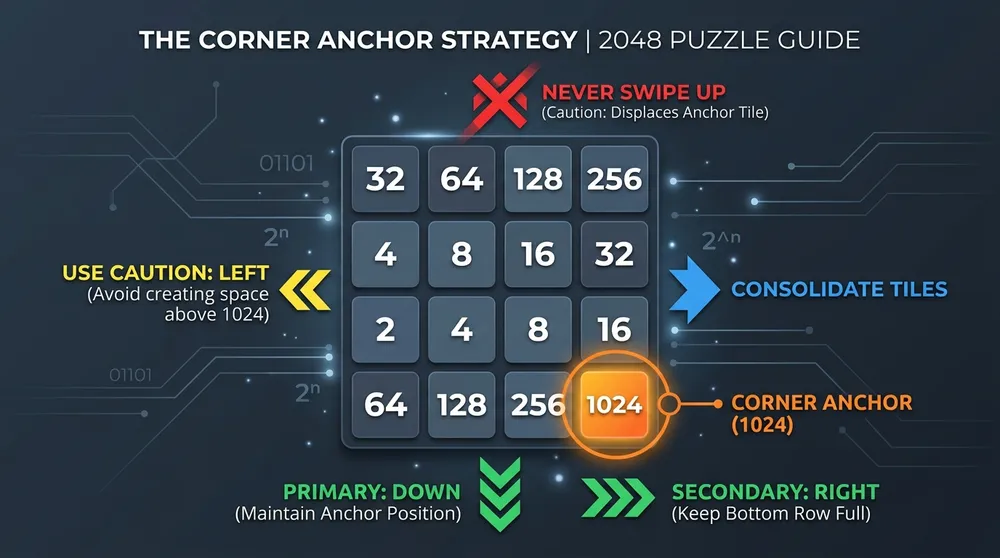
Select one corner at the start of your run and lock it down. The bottom-right corner is standard for most right-handed players because thumbs reach it naturally on mobile screens. Bottom-left works just as well. What matters is total commitment. Once you choose the bottom-right corner, your highest tile must never leave that specific square. If you build a 256 there, it stays there. When it merges into a 512, it stays there. If it slides out of that corner, you lose control of the game.
The Directional Restriction
Choosing the bottom-right corner establishes a strict hierarchy for your directional inputs:
Direction 1: RIGHT. This is your primary slide. It compacts every tile on the board against the right-hand wall.
Direction 2: DOWN. This is your secondary slide. It drops tiles down toward the floor, feeding your bottom row.
Direction 3: LEFT. This is a restricted utility slide. You use it only when moving left does not dislodge your bottom-row structure.
Direction 4: UP. This move is forbidden.
Pressing UP lifts your highest tile away from the bottom wall. The moment your anchor leaves the bottom-right corner, the game engine rolls its random spawn check on all empty squares, including the corner you just abandoned. If a 2 or a 4 spawns in that corner, your highest tile is now stranded on row three. It sits directly above an intruder tile that you cannot easily merge. The entire run enters an emergency state.
Treat the UP key as if it does not exist. Break the habit of swiping up to clear casual pairs in the upper rows. If an upward slide looks tempting, look elsewhere on the board. Find a horizontal slide or a downward compaction that keeps your baseline secure.
The Monotonic Snake Chain
An anchored corner tile is only half the battle. If your bottom-right corner holds a 1024, you cannot feed it with raw 2s. You must merge another 1024 directly into it. That means you need an organized sequence of descending values wrapped across the board like a snake.
Mathematicians call this monotonic ordering. In simple terms: tiles must always decrease in value as they get further from your anchor tile.
Picture a standard winning baseline on row four:
Slot 4,1: 128
Slot 4,2: 256
Slot 4,3: 512
Slot 4,4: 1024 (Corner Anchor)
Every single tile in that row sits next to a neighbor with double or half its value. No numbers are out of order. When you build a 128 on row three and slide it into slot 4,1, a chain reaction ignites across the entire baseline. 128 merges with 128 to make 256. That 256 merges with 512 to make 1024. That 1024 merges with your anchor to produce 2048. Four distinct merge operations execute in a single slide because every piece sits in exact monotonic sequence.
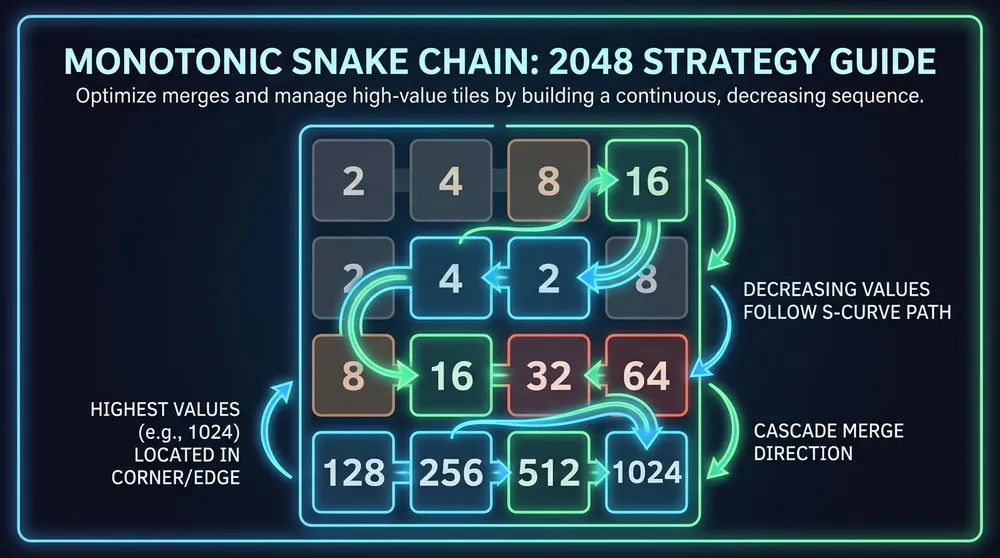
How do you feed that baseline? You snake the chain up into row three:
Row 2: [ Workshop Area: Small numbers ]
Row 3: [ 16 ] [ 32 ] [ 64 ] [ 128 ]
Row 4: [ 128 ] [ 256 ] [ 512 ] [ 1024 ]
Row four flows from left to right, building up toward the 1024 anchor. Row three flows from right to left, building up toward the 128 in slot 3,4. Row three feeds directly into row four.
The tail of your snake lives on rows one and two. That is where you take raw 2s and 4s and combine them into 8s and 16s. Once a tile reaches 16 or 32, you walk it into row three to feed the larger numbers.
The Baseline Wall Rule
The fastest way to ruin a winning run is swiping horizontally while your baseline contains an empty square.
Imagine this board state along your bottom row:
[ Empty ] [ 256 ] [ 512 ] [ 1024 ]
You look at row two. You see two 8s that could merge if you slide LEFT. You swipe left.
Disaster strikes. Because slot 4,1 is empty, row four slides left along with row two. Your tiles shift:
[ 256 ] [ 512 ] [ 1024 ] [ Empty ]
Your 1024 is no longer in the corner. It sits in slot 4,3. Worse, the engine immediately drops a 2 into the vacant bottom-right square:
[ 256 ] [ 512 ] [ 1024 ] [ 2 ]
Your corner is now occupied by a 2. Your 1024 is boxed in between a 512 and a useless low-value tile. You cannot move right because the 2 blocks the wall. You cannot merge the 1024 with anything nearby. Your snake chain is broken.
Commit this rule to memory: never swipe left unless your baseline row contains four solid tiles.
If your bottom row has an open slot, keep sliding DOWN and RIGHT until a tile drops into that gap. Only when all four cells of row four are packed tight can you slide left safely. When the row is completely full, sliding left does not move row four because the tiles have nowhere to slide. Your 1024 remains anchored while the upper rows shift freely.
Managing the Upper Workshop
Rows one and two act as your factory floor. This is where high turnover happens. Small numbers enter the board, get processed, and drop down into the snake chain.
Keep the workshop lean. If you let multiple unmerged 2s linger across rows one and two, your board clogs up fast. Merge matching pairs as soon as they align. Do not let two 4s sit on row one while you mess around with tiles on row two. Fuse them into an 8 to free up a grid square.
Direct all movement toward the right and down. If you need to slide tiles on row one, prefer sliding right. That packs the factory against the right wall, keeping open squares clustered on the left side where new spawns cannot disrupt your heavy assets.
Never build large numbers in the upper-left corner. If an accidental 128 or 256 takes root in row one, you face a structural nightmare. That heavy tile cannot reach your baseline on row four without dragging other tiles out of alignment. It sits there like an anvil, eating up a cell that you need for intermediate merges. Keep small numbers high. Keep big numbers low.
This methodical discipline mirrors what makes tactical board play work in games like Pocket Chess and classic card layouts like FreeCell Solitaire. You do not make moves on a whim. You establish strict positional zones, restrict your pieces to their assigned duties, and let the geometry of the board work for you.
Emergency Protocols for Forced Upward Moves
Every player eventually runs into a forced upward move.
Your baseline is full. Your columns hold mismatched numbers. You scan the options:
Right moves nothing.
Down moves nothing.
Left moves nothing.
The board is locked on three sides. The only physical swipe the game allows is UP.
Do not rage-quit. A forced upward move hurts your board state, but it does not have to destroy your run. Surviving it requires calm execution of a strict recovery protocol.
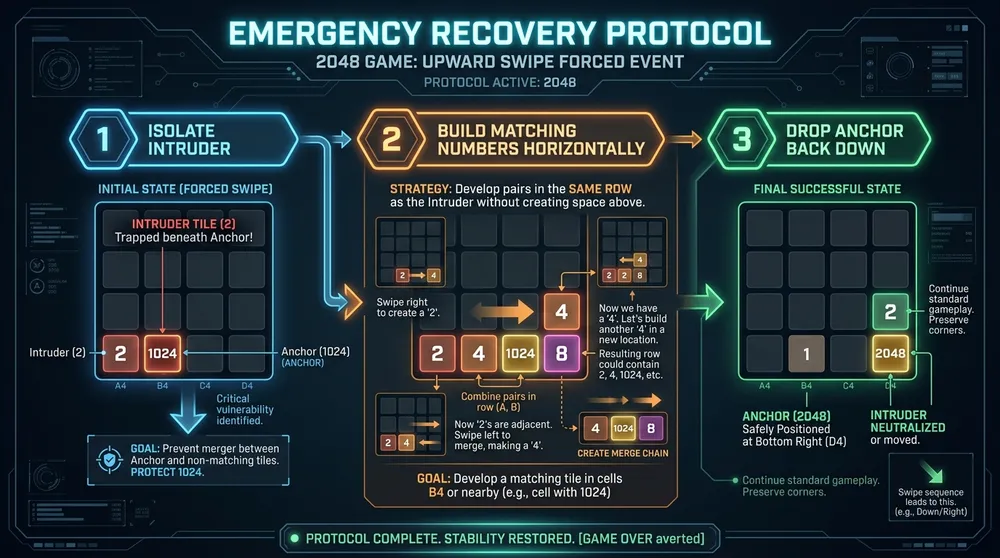
Execute these exact steps in sequence:
1. Scan all four columns before touching the screen. Determine which columns have gaps above them. Those are the columns that will lift.
2. Search for any subtle horizontal merge on rows one or two that might unlock a downward move. If you can fuse two tiles on row one, you might create an opening that lets you slide down instead.
3. If no other move exists, swipe UP once. Do not swipe twice.
4. Check the bottom-right corner immediately to see what spawned.
5. If the corner remained empty, swipe DOWN instantly on the very next turn to restore your anchor to the baseline.
6. If a new tile spawned directly in your corner beneath the anchor, do not panic. Do not start swiping wildly. Your anchor tile is now sitting on row three, and a 2 or 4 occupies your fortress.
7. Identify the intruder. Treat that single square as an isolated repair project.
8. Build matching tiles directly next to the intruder on row four. If the intruder is a 2, build a 2 beside it, slide horizontally to merge them into a 4, then fuse that into an 8.
9. Work the intruder out of the column horizontally. The second you clear that corner square, swipe DOWN to drop your anchor back onto the floor.
Panic swiping after an upward move is what kills runs. A player sees their 1024 lift, gets flustered, and swipes back and forth rapidly trying to shove it down. Five fast swipes fill the rest of the board with junk. Take your hands off the screen. Look at the numbers. Plan the three merges needed to dissolve the intruder tile.
The 90/10 Parity Trap
Because ninety percent of spawns are 2s, your mental math naturally defaults to pairs of 2s. You expect the board to give you 2s. You plan your slides around 2s.
When the engine drops a 4 into an open slot, it disrupts your cadence.
Suppose you have an isolated 2 sitting in row two. You need one more 2 to create a 4, which you plan to drop into row three to feed an 8. You swipe to align the board, expecting an open space to catch a 2. The game spawns a 4 instead.
Now you have a 2 and a 4 occupying adjacent squares. They cannot merge. Neither tile can leave its square until you feed it a matching number. You have two dead cells on a board that only has sixteen squares to begin with.
Counter this trap with active parity management. Never leave an isolated 2 stranded without an open adjacent cell. If an unexpected 4 spawns in your workshop, treat it as a top priority. Build an immediate 4 beside it to fuse them together before that mismatch spreads to surrounding rows. Clearing dead cells matters more than advancing your highest tile.
Pushing to 4096 and 8192
Clearing the 2048 tile triggers a victory banner, but the game continues as long as legal moves remain. Pushing beyond 2048 to 4096 and 8192 changes the math drastically.
When you hold a 2048 tile in the corner, building a second 2048 to reach 4096 requires complete baseline saturation. Your bottom row will look like this:
[ 256 ] [ 512 ] [ 1024 ] [ 2048 ]
Every single square along your baseline is frozen. None of those numbers can merge until you construct another 256 on row three.
That means you no longer have sixteen squares to play with. You have twelve. Row three becomes a secondary baseline, locked down with its own descending sequence:
Row 3: [ 128 ] [ 64 ] [ 32 ] [ 16 ]
Row 4: [ 256 ] [ 512 ] [ 1024 ] [ 2048 ]
Once rows three and four are locked, you are playing the entire game on rows one and two. You have eight squares total.
To build a 128 tile inside an eight-square box, your merge precision must be absolute. One misplaced 4 cuts your usable space down to seven squares. Two misplaced tiles leave you with five squares, which is not enough room to construct an intermediate tile from scratch.
Computer scientists studying 2048 with expectimax search algorithms have mapped out these probability thresholds. In an expectimax framework, an algorithm evaluates the tree of all possible player moves alongside all possible random tile spawns, assigning a utility value to each board state. These models prove that maintaining strict monotonicity across both the primary and secondary rows yields a win rate above ninety-five percent for 2048, and roughly seventy-eight percent for 4096.
The theoretical mathematical ceiling on a standard four-by-four grid with a ten percent 4-spawn rate is 131,072. Human players have reached 32,768 and 65,536 on verified records using these exact snake-chain constraints. Reaching those numbers is not about luck. It is about emotional control.
Speed and Muscle Memory
The primary obstacle to a high score in 2048 is finger speed.
After five minutes of steady play, sliding tiles becomes rhythmic. Swiping right-down-right-down feels satisfying. The visual feedback of numbers merging creates momentum, and your hands start moving on autopilot.
That is when the fatal mistake happens. Your thumb swipes up to clear a small pair on row one without checking the baseline. The anchor lifts. A random 4 spawns under your 2048. The run falls apart thirty seconds later.
Break that autopilot habit by applying three operational rules to every turn:
Rule 1: Cap your speed at one move per second once your anchor passes 256. Slow play forces your eyes to confirm the board state before your fingers touch glass.
Rule 2: Check your anchor before every swipe. Confirm that your largest tile is physically in the corner and that the bottom row has four tiles before touching left.
Rule 3: Count your empty cells. When available spaces drop to three or fewer, stop completely. Do not swipe until you have mentally calculated the next three board states.
Run the board like a system. Keep your fortress locked. Feed the snake from the tail, and never touch the UP arrow unless the board forces your hand.
Frequently Asked Questions
No. Because tile spawns occur on random open squares, rare sequences of hostile tile spawns create mathematically unwinnable boards. However, strict corner anchoring raises your practical win rate on standard four-by-four grids from less than five percent to over eighty-five percent.
Download Free Shikaku Logic Puzzle Student Worksheet & Rules (PDF)
Save a copy to your computer or print for your classroom or game club.

Game developer and founder at Unicorn Games. Specializes in combinatorial game theory, solvability algorithms, and classic card & puzzle game development. Every guide is fact-checked against mathematical game states and empirical play benchmarks.