How to Win Minesweeper: Board Deduction, Pattern Formations, and Probability Calculation
Novice players approach Minesweeper as an exercise in blind luck. They click random gray tiles across the grid, uncover a few numbers, freeze when the board tightens, and detonate a mine on an arbitrary guess. They blame bad fortune for their losses.
Minesweeper is a pure system of discrete mathematics, Boolean algebra, and deterministic spatial deduction. Every numerical clue on the board states an exact constraint: the precise quantity of mines hiding in the eight adjacent cells surrounding that number. Skilled players do not guess unless the board reaches an irreducible 50/50 trap. They execute direct reductions, spot fixed geometric patterns, use chording shortcuts, and track global mine counts.
You can apply these deductive rules right now by playing Retro Minesweeper on Unicorn Games in your browser.
Origins, Board Specifications, and Computational Complexity
Minesweeper roots trace back to early mainframe games of the 1960s and 1970s, including Jerimac Ratliff's Cube. In 1989, Robert Donner and Curt Johnson wrote the game for Microsoft Windows Entertainment Pack, and Microsoft bundled it with Windows 3.1 in 1992. The original corporate purpose was utilitarian: teaching office workers how to use the mouse, specifically right-clicking to flag and dual-clicking to chord.
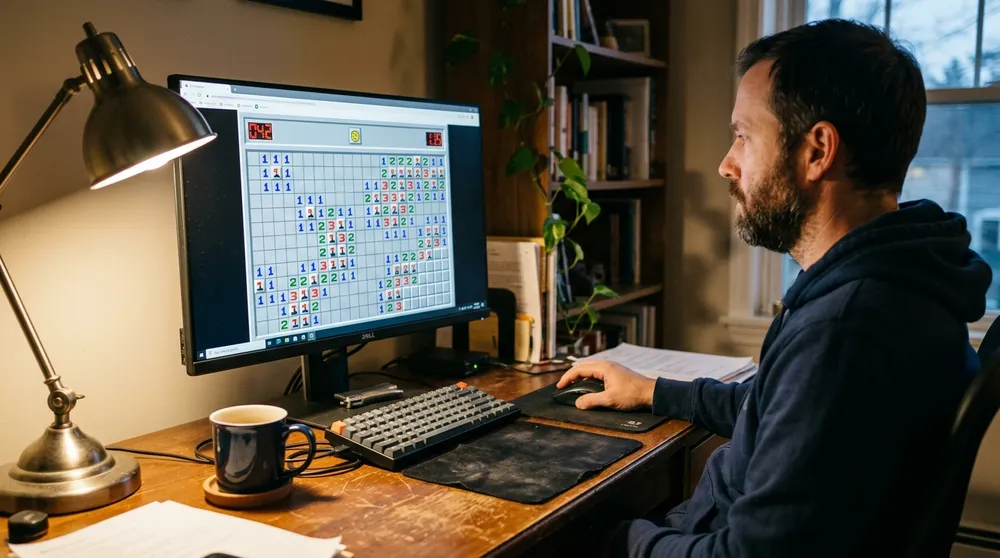
In 2000, mathematician Richard Kaye published a formal proof demonstrating that determining whether a given Minesweeper board state has a consistent configuration of mines is NP-complete. In practical terms, no algorithm can solve every arbitrary grid in polynomial time. You will face situations where logical certainty is mathematically impossible. Your objective is eliminating every preventable error so those forced guesses remain your only point of failure.
Standard competitive play uses three fixed difficulty formats:
Every additional mine per unit area sharpens the deductive requirements. An Expert board forces you to manage four hundred and eighty individual tiles under a tight twenty percent mine load.

The Core Arithmetic of Cell Clues
Every revealed tile displays an integer between 1 and 8, or opens as a blank empty space. An empty space indicates zero mines in all eight neighboring cells, triggering an automated cascade that pops open every contiguous empty cell until it hits numbered boundaries.
The core relationship is a linear system:
$$\sum_{k \in \text{Neighbors}(i, j)} M_k = C(i, j)$$
Here $M_k \in \{0, 1\}$ represents the presence of a mine in adjacent unrevealed cell $k$, and $C(i, j)$ is the clue number shown on cell $(i, j)$.
When the quantity of unopened neighboring cells equals the number displayed on the clue, every single one of those unopened cells is a mine. If a 1 touches exactly one unrevealed cell, that cell holds a mine. Flag it immediately.
When the quantity of confirmed flags around a clue equals the number on the clue, every remaining unopened cell touching that number is safe. Open them immediately.
Mastery starts by recognizing when multiple neighboring clues share common mystery cells. That overlap reduces unknown variables into instant answers.
Master Wall Patterns: The Geometry of Direct Deduction
Experienced sweepers never scan cell by cell. They identify spatial clusters instantly through pattern recognition.
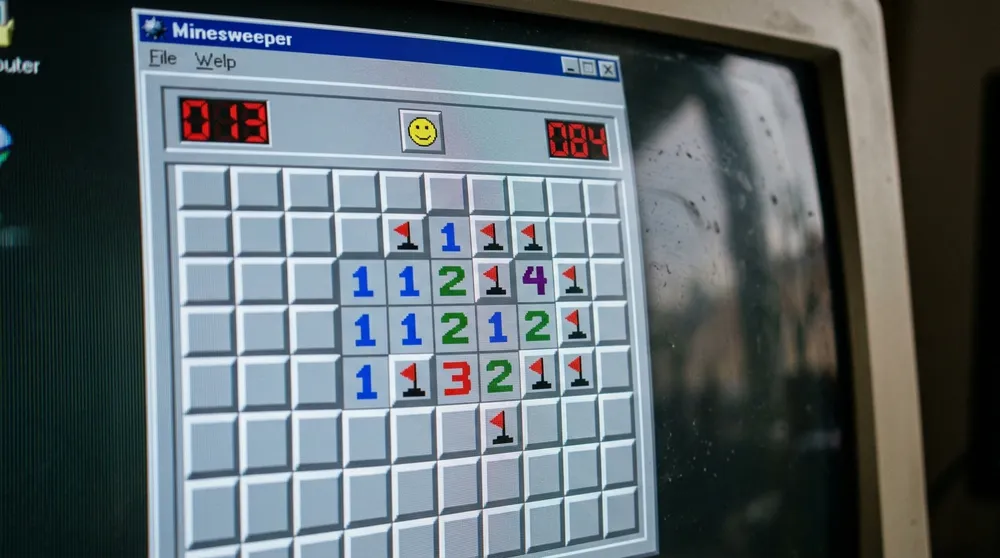
The 1-2-1 Pattern Along a Straight Wall
The 1-2-1 sequence along a flat wall of unopened tiles is the most famous pattern in the game.
Consider three consecutive numbered tiles displaying 1, 2, and 1 along a straight horizontal edge of unopened squares:
| Unopened A | Unopened B | Unopened C |
|:---:|:---:|:---:|
| 1 | 2 | 1 |
Here is the exact mathematical proof:
1. The left 1 touches Unopened A and Unopened B. Exactly one of these two cells contains a mine.
2. The right 1 touches Unopened B and Unopened C. Exactly one of these two cells contains a mine.
3. The middle 2 touches Unopened A, Unopened B, and Unopened C. It requires exactly two mines among those three cells.
4. If Unopened B contained a mine, it would satisfy the left 1 and the right 1 simultaneously. That would force Unopened A and Unopened C to be safe. But if Unopened A and C were safe, the middle 2 would touch only one mine (Unopened B), violating its requirement of two mines.
5. Therefore, Unopened B cannot contain a mine. Unopened B is guaranteed safe.
6. To satisfy the middle 2, both Unopened A and Unopened C must contain mines.
Rule: On any flat 1-2-1 formation, the cells directly facing the 1s are always mines. The cell directly facing the middle 2 is always safe. Click the center cell without hesitation.
The 1-2-2-1 Pattern Along a Straight Wall
When you encounter four consecutive tiles reading 1, 2, 2, 1 along a flat unopened boundary:
| Unopened A | Unopened B | Unopened C | Unopened D |
|:---:|:---:|:---:|:---:|
| 1 | 2 | 2 | 1 |
1. The outer 1 on the left means either Unopened A or B holds a mine.
2. The outer 1 on the right means either Unopened C or D holds a mine.
3. The left 2 requires two mines between A, B, and C. Since the 1 limits A and B to one mine, Unopened C must contain a mine.
4. The right 2 requires two mines between B, C, and D. Since the right 1 limits C and D to one mine, Unopened B must contain a mine.
5. With Unopened B confirmed as a mine, the left 1 is fully satisfied. Unopened A is guaranteed safe.
6. With Unopened C confirmed as a mine, the right 1 is fully satisfied. Unopened D is guaranteed safe.
Rule: In a 1-2-2-1 wall formation, the cells opposite the two 2s are always mines. The cells opposite the outer 1s are always safe.
The 1-1 Pattern (Effective Reductions)
A 1-1 formation occurs when two 1s sit side by side against a wall, but one of those 1s also touches empty space or has already satisfied part of its boundary.
| Empty | Unopened A | Unopened B | Unopened C |
|:---:|:---:|:---:|:---:|
| Safe | 1 | 1 | ... |
If the left 1 only touches Unopened A and Unopened B, you know that one of those two cells is a mine. The right 1 touches Unopened A, Unopened B, and Unopened C. Because the left 1 confirms that the mine must reside within {A, B}, the right 1 has its requirement completely met by that same pair. Unopened C cannot hold a mine. Unopened C is safe to open.
Always subtract known information from neighboring clues. A 3 that already touches two confirmed flags functions as a 1 for all remaining unopened neighbors. Reduce every complex number to its effective value.
Corner Reductions and Island Logic
Edges and corners drastically cut down the number of neighbors a cell possesses:
Use these structural constraints to crack locked borders:
The Corner 1 Trap
When a 1 sits on an interior corner touching exactly two unopened diagonal squares:
| Wall | Unopened A | Unopened B |
|:---:|:---:|:---:|
| Wall | 1 | Wall |
The mine must reside in Unopened A or Unopened B. If another number outside that corner touches both A and B, that number has its mine quota satisfied by the pair. Any third cell touching that outside number is guaranteed safe.
The Protruding 2 (The T-Junction)
When a 2 sticks out into unexplored territory touching exactly three unopened cells in a T-shape, look for adjacent 1s. If an adjacent 1 shares two of those three squares, the lone third square that touches only the 2 is guaranteed to contain a mine. Flag it and subtract it from the 2, converting the 2 into a simple 1.
Chording Mechanics and the 3BV Speed Metric
Speed in Minesweeper is not about moving the mouse faster. It is about clicking fewer times.
How Chording Works
Chording is a software feature built into standard Minesweeper clients. Once you place the correct number of flags around a revealed number, clicking that number with both mouse buttons at once (or pressing the middle scroll wheel) instantly reveals all remaining unflagged neighbors.
Compare the manual process against chording:
On an Expert grid with 480 cells, chording cuts required mouse clicks by forty to fifty percent.
The 3BV Metric (Bechtel's Board Benchmark Value)
Competitive speedrunning ranks players using 3BV, invented by Stephan Bechtel. 3BV measures the minimum number of left-clicks required to solve a board without placing any flags.
Every opening cascade counts as 1 3BV. Every isolated cell that must be clicked individually adds 1 3BV. The total 3BV of an Expert board typically ranges between 90 and 140.
Elite speedrunners track their 3BV/s (3BV completed per second). Top players maintain rates between 3.5 and 5.0 3BV/s. To achieve speeds like that, you cannot waste clicks placing defensive flags on obvious open ground. You flag only when it enables a high-value chord.
Flagging vs. Non-Flagging (NF)
Competitive players divide into two disciplines:
1. Flagging style: Players flag confirmed mines to execute chords. This requires more total clicks, but lowers mental cognitive load by visualizing cleared areas.
2. Non-flagging (NF) style: Players never right-click. They leave mines bare and left-click only safe cells. This minimizes total inputs and eliminates flag-placement latency, but demands flawless spatial memory.
For general win-rate optimization, use hybrid play. Flag mines along dense contested borders to unlock chords. Leave isolated mines in quiet quadrants unflagged.
Probability Calculus: Surviving the Unavoidable Guesses
No matter how sharp your deduction, some boards cannot be solved by logic alone. You will reach positions where two unrevealed cells touch a 1 with zero outside clues. This is the 50/50 trap.
The Math of Clock Equity and Early Guessing
When you identify an unavoidable 50/50 coin flip, do not postpone it. Guess immediately.
Amateur players leave 50/50 traps until the end of the game. They spend four minutes meticulously clearing the rest of a massive Expert board, only to die on the final coin flip. That represents four minutes of wasted mental effort.
If you hit a pure 50/50 split on turn twenty, guess right away:
Always protect your clock equity. An unavoidable guess does not become safer by waiting.
Global Mine Density vs. Local Density
When forced to guess outside an obvious 50/50, compare local cell probabilities against the global mine counter.
Look at the remaining mine counter in the top-left corner. Divide the remaining mines by the total unopened cells remaining on the board:
$$P_{\text{global}} = \frac{\text{Mines Remaining}}{\text{Unopened Cells Remaining}}$$
On an Expert board, early global mine density is roughly 20.6%.
Now evaluate your local options:
In this scenario, clicking the blind corner square is more than twice as safe as guessing randomly on the local 50% border. Calculate the fractions before touching a tile.
The Five-Stage Expert Clearance Protocol
To sustain consistent win rates above forty percent on 30x16 Expert grids, execute your game plan through five disciplined stages:
1. Opening Cascade Search: Click inside the center quadrant on your first move. Modern clients ensure the first click never hits a mine and opens a zero-cascade. If your opening click yields an isolated number with no cascade, click an adjacent center tile until a large opening pops.
2. Boundary Sweeping: Work the perimeter of the open space. Identify all obvious 1-touching-1 cells, corner mines, and direct reductions. Flag verified mines and middle-click to chord open safe territory.
3. Pattern Scanning: When simple deductions stop, scan the borders for 1-2-1 and 1-2-2-1 formations. Apply overlapping set subtractions to reduce multi-clue sequences.
4. Mine Count Accounting: In the endgame, check the mine counter. If the counter reads 2 mines remaining and you have two distinct clusters that each require at least one mine, every other unrevealed cell on the entire board is guaranteed safe. Open them all.
5. Forced Guess Triage: When logic runs dry, locate pure 50/50 splits and resolve them instantly. If no 50/50 exists, compute the cell with the lowest mine probability using local neighbor counts or global density, click it, and resume standard deduction upon survival.
Frequently Asked Questions
In modern implementations, including retro web versions, your first click is guaranteed safe. The software generates mine coordinates only after your first click, ensuring that your starting cell is never a mine and almost always opens an empty cascade. On ancient 1990s Windows releases, clicking an unrevealed square on turn one could occasionally hit a mine.
Download Free Shikaku Logic Puzzle Student Worksheet & Rules (PDF)
Save a copy to your computer or print for your classroom or game club.

Game developer and founder at Unicorn Games. Specializes in combinatorial game theory, solvability algorithms, and classic card & puzzle game development. Every guide is fact-checked against mathematical game states and empirical play benchmarks.