How to Win Spider Solitaire: 1, 2, and 4-Suit Winning Strategies
Spider Solitaire is a relentless mechanical puzzle disguised as a casual card game. Two full decks of cards, one hundred and four in total, get divided across ten tableau columns and a fifty-card stock deck. Fifty-four cards start on the board. Forty-four of those cards sit face-down, dark and hidden. You get five stock deals of ten cards each. That is the entire battlefield.
Most casual players treat Spider Solitaire like Klondike with extra columns. They build mixed-suit runs aimlessly, hit a wall on the third stock deal, and abandon the game in frustration. In four-suit mode, the average player wins fewer than five out of every one hundred games.
Master players win over thirty-five percent of their four-suit deals without undo buttons, and over eighty-five percent of their two-suit games. In one-suit mode, their win rate approaches ninety-nine percent.
The gap between failure and mastery comes down to understanding the economy of empty columns, the mechanics of suit consolidation, and the disciplined preparation required before touching the stock deck.

The Anatomy of the Deal and Mathematical Realities
Spider Solitaire distributes one hundred and four cards across two distinct sectors:
1. The Tableau: Fifty-four cards are dealt into ten columns. The first four columns receive six cards each (five face-down, one face-up). The remaining six columns receive five cards each (four face-down, one face-up). Only ten cards start face-up and immediately playable.
2. The Stock Pile: Fifty cards remain in reserve, organized into five separate deals of ten cards each.
3. The Target: Build eight complete thirteen-card sequences descending from King down to Ace in the same suit. Once a sequence is complete from King to Ace in a single suit, it vanishes from the board into the foundation.
The math of the game is unforgiving. Unlike FreeCell, where nearly every card is visible from the opening second, Spider Solitaire is half-blind. You must uncover forty-four hidden cards to assemble your eight foundation sets.
Every face-down card represents dead weight. A column with four face-down cards is a clogged pipeline. Your primary goal from the opening move is not building beautiful descending runs; it is drilling down to turn over those hidden cards.
The Win-Rate Hierarchy: 1, 2, and 4 Suits
Spider Solitaire changes fundamentally depending on how many suits you activate:
In 1-Suit mode, every single card belongs to the same suit, typically Spades. Every card can move onto any other card of higher rank, and every completed descending run can be moved as a whole unit. Because there are no off-suit blocks, 1-Suit mode is essentially a test of patience. The winnable percentage is roughly ninety-nine percent. If you lose a 1-Suit game, you made a catastrophic blunder in column management.
In 2-Suit mode, fifty-two cards are black (Spades) and fifty-two cards are red (Hearts). You can stack a red card on a black card, but you cannot move that combined group together. Only pure same-suit runs can travel as a pack. The winnable threshold sits around eighty to eighty-five percent for methodical players.
In 4-Suit mode, all four traditional suits enter the arena: Spades, Hearts, Diamonds, and Clubs. Twenty-six cards per suit. Stacking off-suit cards becomes an inescapable necessity to survive, yet every off-suit overlap paralyzes your mobility. Master players reach thirty to thirty-five percent win rates in strict play, and up to fifty percent when using deliberate recursive backtracking.
The Priority Hierarchy: What to Do on Every Move
Amateur players scan the board looking for any legal move. This is why they lose.
Spider Solitaire demands a strict priority order. When analyzing any board state, run through these decisions in sequence:
First priority: Turn over face-down cards. If two different moves are available, always choose the move that exposes a face-down card. If you can put a Seven of Spades on an Eight of Spades in column three, or put a Seven of Clubs on an Eight of Diamonds in column six to flip a hidden card, you choose column six. Exposing hidden information unlocks future moves. Leaving hidden cards buried guarantees stagnation.
Second priority: Clear a column completely. An empty column is the single most powerful tactical asset in Spider Solitaire. Creating an empty space should be pursued relentlessly, even if it requires temporarily breaking an in-suit sequence.
Third priority: Consolidate mixed suits into pure suits. If you have an off-suit sequence like Jack of Spades, Ten of Diamonds, Nine of Diamonds, look for ways to transfer that Ten-Nine onto a Ten of Spades to restore suit purity. Pure suit runs can be moved as a unit; mixed runs are immovable bricks.
Fourth priority: Build in-suit rather than out-of-suit. When all other factors are equal, prefer placing a Six of Hearts on a Seven of Hearts rather than on a Seven of Spades. Same-suit stacks preserve your freedom of movement.
Fifth priority: Deal from the stock deck. Touching the stock is an irreversible, destructive event. It drops one random card onto all ten columns, burying whatever work you have accomplished. Never touch the stock until you have exhausted every single legal play, flip, and consolidation on the active board.
The Absolute Power of the Empty Column
An empty column is not a vacant parking spot. It is an engine of transformation.
In FreeCell, you have designated reserve cells to temporarily park cards. In Spider Solitaire, the empty tableau column serves that exact function. Without an empty column, your ability to rearrange cards is severely limited. With one empty column, you can untangle complex multi-card knots. With two empty columns, you can manipulate entire stacks at will.
The mathematical rule governing empty columns is straightforward:
With one empty column, you can temporarily park a card, shift the blocking cards beneath it, and move the parked card back.
With two empty columns, your mobility explodes. You can break apart a five-card mixed stack, distribute the components across the two open slots, re-sequence them into pure suits on target columns, and clear both columns out again.
The King Parking Rule
The most common way players destroy an empty column is by parking a lone King in it immediately.
Do not move a King into an empty column unless one of two conditions is met:
1. Moving that King exposes a face-down card in the column it left behind.
2. You can immediately build a long, pure in-suit sequence starting from that King down to the Six or Five.
If you park a lone King into your only open column simply because the slot is vacant, you have traded your most versatile weapon for a static piece of wood. A King cannot be placed on any other card. Once a King occupies an empty column, that column is dead until you assemble the entire King-to-Ace sequence on top of it. Guard your empty columns with your life.

In-Suit Consolidation vs Off-Suit Bridging
Spider Solitaire permits you to place any card on a card one rank higher, regardless of suit. You can drop a Three of Clubs on a Four of Hearts. This is called an off-suit bridge.
Off-suit bridging is a tactical compromise. It buys you temporary access to cards buried underneath. But it extracts a heavy toll:
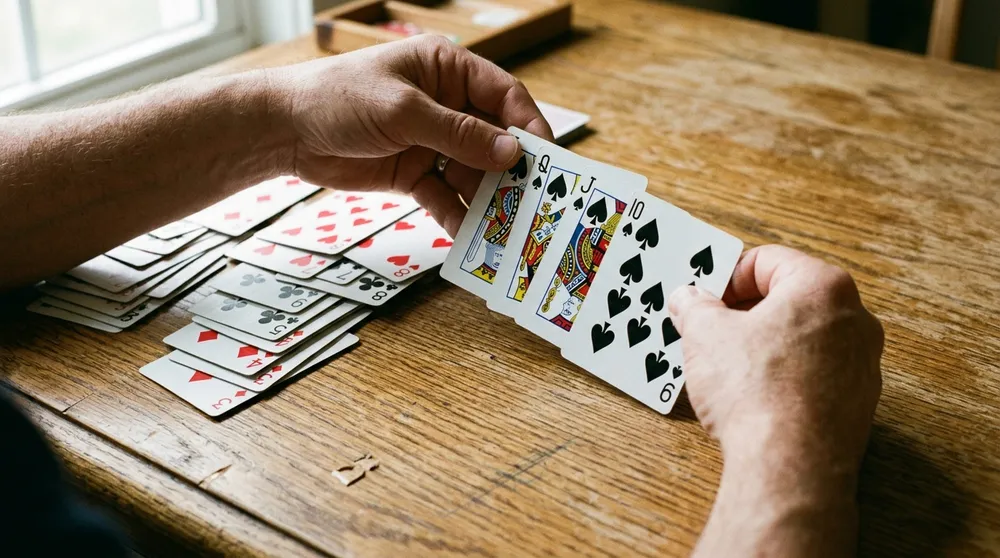
A run of same-suit cards (Nine, Eight, Seven of Spades) moves together as a single block. You can lift all three cards at once and place them on a Ten of Spades in another column.
A mixed run (Nine of Spades, Eight of Hearts, Seven of Spades) is legally frozen. You can only move the bottom card, the Seven of Spades. The Nine and Eight cannot travel together because their suits do not match. To move the Eight, you must first find a home for the Seven. To move the Nine, you must dismantle the Eight.
Every off-suit bridge you build adds dead weight to your tableau. If you build five off-suit bridges across the board, your mobility drops to zero.
The Vacuum Cleaner Technique
Before dealing from the stock, execute the vacuum cleaner technique:
Scan the board for disjointed fragments of the same suit scattered across different columns. Use your empty columns as temporary staging areas to collect those fragments into a single, cohesive in-suit run.
For example, if column two has an Eight and Seven of Hearts sitting under a black Jack, and column seven has a Six and Five of Hearts exposed, do not leave them divided. Move the Six and Five onto the Eight and Seven. Whenever you unite matching suits, you restore moving capability to those cards.
Preparing the Board for the Stock Deal
The stock deck contains fifty cards dealt in five waves of ten. Each wave places one card onto every single column, without exception.
This mechanic introduces chaos. If you have an empty column, the game will not allow you to deal from the stock in standard rules; you must fill every column before dealing. And when that new row of cards lands, it lands on top of your existing work. An Ace landing on your Nine-through-King run seals that entire stack under a useless lid.
To survive a stock deal, prepare the board meticulously:
1. Never leave an exposed Ace or Two at the bottom of a column if you can avoid it. When the stock deals an arbitrary card on top of an Ace, that Ace is buried and useless, because nothing can be built on top of an Ace.
2. Maximize in-suit depth before dealing. If you have clean sequences, try to consolidate them so the new card lands on top of a unified stack rather than a broken mess.
3. Keep track of column depth. Columns with only one or two cards are precious. If a stock deal drops a single card into a shallow column, you can clear it again quickly. A column that already has fifteen stacked cards will become almost impossible to dig through once buried under another layer.
4. Fill empty columns with disposable cards just before dealing. If you must fill an empty column to trigger the deal, place a card that offers immediate follow-up potential, or a lone card that can be easily shifted back out once the deal is complete.
Mode-Specific Strategic Blueprints
Different suit modes require distinct mental frameworks. What works in one suit will lead to instant failure in four suits.
The 1-Suit Blueprint
In 1-Suit Spider Solitaire, off-suit penalties do not exist. Every card you see belongs to Spades.
Your strategy is purely linear:
Prioritize clearing columns above all else. Because any card can be shifted onto any higher card, creating two or three empty columns is relatively simple. Once you hold three empty columns, you can manipulate thirty or forty cards at a time.
Build from King down to Ace systematically. Do not assemble fragments halfway across six different columns. Focus on completing one full thirteen-card suit at a time to clear it off the board and permanently expand your workspace.
The 2-Suit Blueprint
With two suits (Spades and Hearts), color separation becomes your central focus.
Adopt a dual-column strategy: dedicate specific columns to black cards and specific columns to red cards whenever possible.
If you must cross suits, cross them high on the ladder. Placing a red Jack on a black Queen is manageable because high-rank cards stay on the board longer. Crossing suits at the bottom (putting a red Three on a black Four) is dangerous, because low-rank cards get buried quickly and block foundation assembly.
Never cross suits twice in the same stack if you can avoid it. A sequence of Spade-Heart-Spade-Heart is a disaster that requires four separate maneuvers to untangle. Keep your mixed stacks as simple two-layer sandwiches: a pure run of Spades sitting on top of a pure run of Hearts.
The 4-Suit Blueprint: The Survivalist Strategy
In 4-Suit Spider Solitaire, you cannot afford idealism. You will be forced to make bad moves. You will be forced to bury cards under conflicting suits. The secret to winning is managing the damage.
Designate two primary working suits. In the opening phase, observe which two suits appear in the greatest volume or have the cleanest natural runs. Treat those two suits as your builders.
Treat the other two suits as trash suits. Use cards from the trash suits as temporary stepping stones to expose hidden cards. If you need to flip a card in column four, do not hesitate to throw an off-suit Diamond onto a Club to clear the path.
Ruthlessly sacrifice suits to create empty columns. In 4-Suit mode, an empty column is worth more than a six-card pure run. If breaking up a clean sequence of Hearts yields an empty column, break it. The empty column will give you the tactical flexibility to rebuild the Hearts later, while digging up two more face-down cards in the process.
Advanced Maneuvering: The Shift Formula
When you have empty columns, you can perform multi-card shifts that appear impossible at first glance.
Suppose you have an empty column and you want to move a mixed-suit stack of three cards (Seven of Spades, Six of Hearts, Five of Diamonds) that is resting on an Eight of Clubs, and you want to access the card underneath the Eight.
You cannot move all three cards together because their suits do not match. But with one empty column and an available Nine of any suit elsewhere on the board:
1. Move the Five of Diamonds to the empty column.
2. Move the Six of Hearts to the Nine in the other column.
3. Move the Five of Diamonds from the empty column onto the Six of Hearts.
4. Now the Seven of Spades sits exposed. Move the Seven of Spades to an available Eight elsewhere.
5. The original column is now unlocked, allowing you to flip the face-down card underneath.
This recursive shifting is the hallmark of advanced play. Before concluding that a board is dead, trace every possible permutation through your empty columns. Nine times out of ten, a path exists to peel away the blocking cards and reveal the prize below.
Endgame Execution: Assembling the Final Foundations
As you enter the final two stock deals, the character of the game shifts from survival to consolidation.
At this stage, you should have removed at least two or three complete suits from the board, or you should hold multiple empty columns. If all ten columns remain clogged with deep, mixed stacks by the fifth stock deal, the game is lost.
When the final stock deal lands, stop rushing. Do not clear cards to the foundation prematurely if those cards are still useful as stepping stones.
A King-through-Ace sequence that vanishes from the board removes thirteen cards of that suit permanently. That reduces the clutter. But it also removes thirteen cards that could have served as landing pads for other descending runs. If clearing a completed suit leaves you with no remaining Eights or Sevens to park your other cards, wait. Keep the completed run on the board for a turn or two until your remaining stacks are positioned safely, then let it clear into the foundation.
Count every card remaining in the deck. If you are hunting for the final Six of Clubs to unlock a column, check the board. There are exactly two Sixes of Clubs in the game. If one is already buried in column nine and the other is sitting in column two, you know with absolute mathematical certainty that no other Six of Clubs exists. You must dig for the one on the board rather than hoping for a miracle.
Approach each deal with discipline, respect the power of the empty column, never touch the stock until the board is exhausted, and you will transform Spider Solitaire from a game of chance into a masterclass in systematic logic. Ready to test your skills across 1, 2, and 4 suits? Play Spider Solitaire free in your browser on Unicorn Games.
Download Free Klondike Solitaire Rules & Strategy Cheat Sheet (PDF)
Save a copy to your computer or print for your classroom or game club.

Game developer and founder at Unicorn Games. Specializes in combinatorial game theory, solvability algorithms, and classic card & puzzle game development. Every guide is fact-checked against mathematical game states and empirical play benchmarks.