High-Stakes Card Battles: Pro Tips for Spades, Hearts, Gin Rummy & Blackjack
Card games divide players into two camps. Amateurs play the cards in their hands. Tacticians play the cards remaining in the deck.
Spades, Hearts, Gin Rummy, and Blackjack look simple on the surface. Pick up cards, follow suit, form sets, hit or stand. But behind every dealt hand sits a rigorous mathematical reality governed by incomplete information, combinatorial probability, and shifting risk profiles. Treating Spades like Hearts ruins your partnership. Playing Gin Rummy like Blackjack empties your bankroll. Mastery across all four disciplines requires understanding exact counting thresholds, defensive table positioning, and statistical expected value.

The Unified Mathematics of Card Battles
Every card game is an information extraction problem.
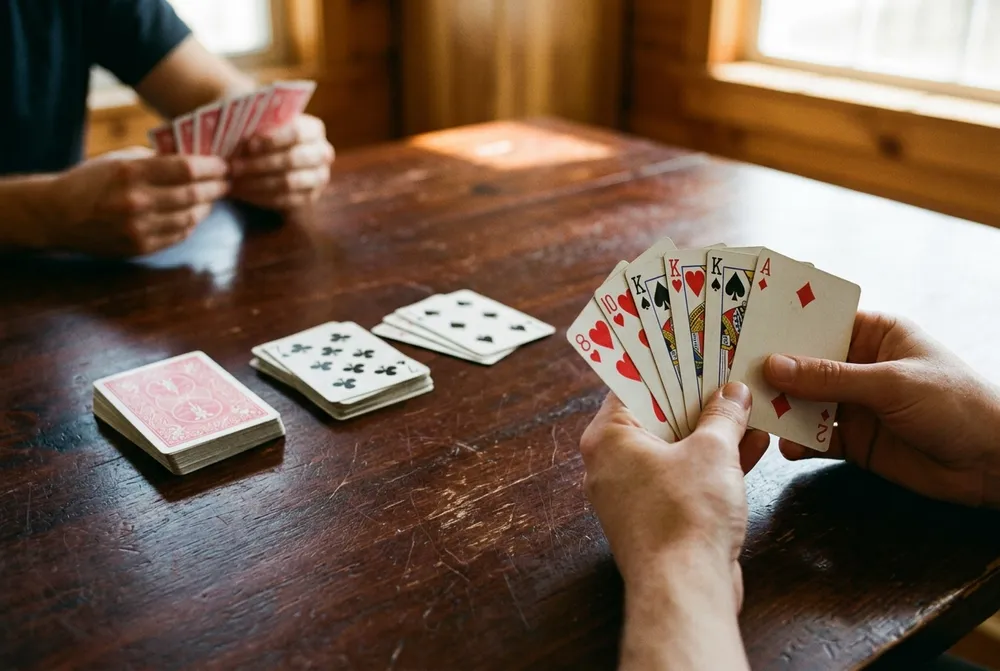
In a standard 52-card deck, four players in Spades or Hearts hold 13 cards each. At the start of trick one, you know your 13 cards and zero cards held by the other three players. That leaves 39 hidden cards distributed across three hands. As each trick resolves, four cards move from the hidden state to the revealed state. By trick six, 24 cards have been played. The remaining possibilities collapse rapidly.
In Gin Rummy, two players receive 10 cards each, leaving 32 cards split between the stockpile and the discard pile. Every card drawn from the discard pile gives away perfect information about your opponent's meld intentions. Every card drawn from the closed deck keeps your plans concealed.
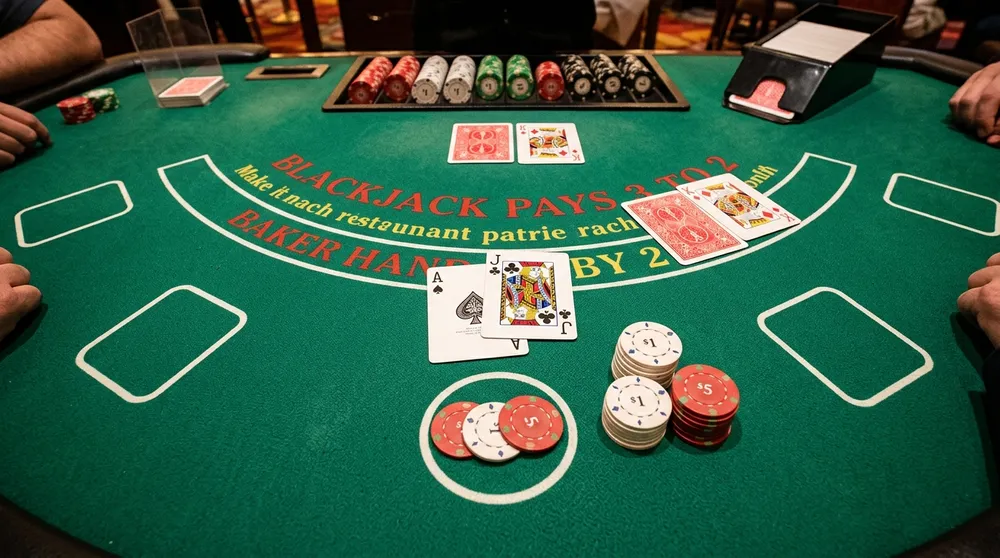
Blackjack removes multiplayer psychology and replaces it with pure fixed-rule dealer probabilities. The dealer must draw to 16 and stand on 17. The house edge sits between 0.5% and 2% depending on deck shoe depth and table rules. You play against a deterministic dealer script rather than a human mind.
Spades: Partnership Bidding, Trump Control, and Bag Discipline
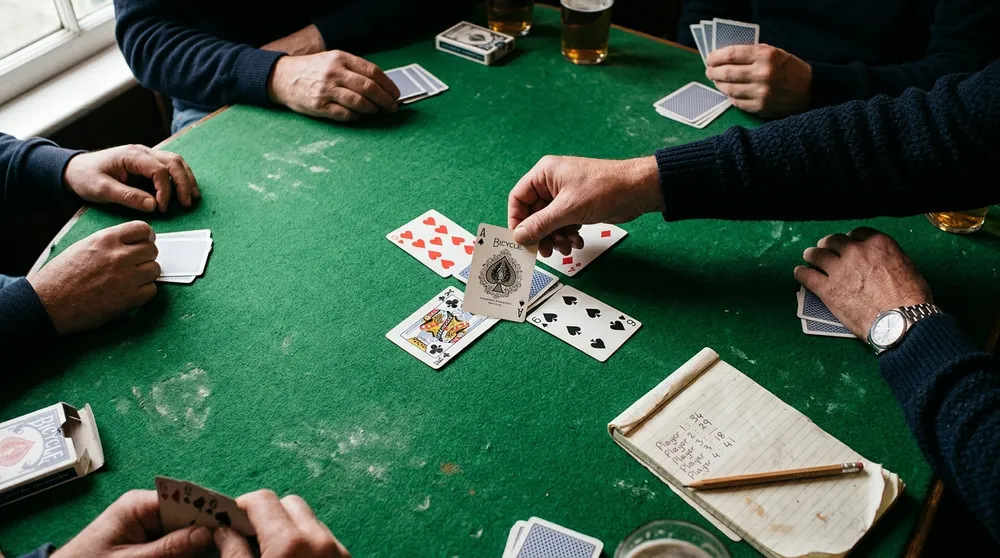
Spades is a game of cooperative precision. Your individual score means nothing. Only the combined bid of you and your partner matters.
The standard game runs to 500 points. If your team bids 7 tricks and takes 7 tricks, you earn 70 points. If you take 6 tricks, you get set and lose 70 points. But if you take 8 tricks, you get 71 points: 70 for the bid and 1 overtrick, commonly called a bag. Accumulate 10 bags across multiple hands, and your team suffers a brutal 100-point penalty. Bag management separates mediocre players from champions.
The Arithmetic of Nil Bidding
A successful Nil bid earns 100 bonus points. A failed Nil bid costs 100 points, and all tricks taken by the Nil bidder convert directly into bags.
Never bid Nil based on hope. A proper Nil requires specific structural hand conditions:
1. Low card insulation: you must hold cards ranked 2 through 6 to duck under leads.
2. A safe spade holding: an ideal Nil spade suit has three or four cards all ranked below 8 (such as 2, 4, 6, 7). Having only one or two spades is dangerous because you will be forced to trump an opponent's lead early.
3. No unprotected honors: holding a lone King or Queen in any side suit without the Ace or supporting low cards is fatal. If the suit is led twice, your King will take the trick whether you want it to or not.
When your partner bids Nil, your entire role transforms. You must bid aggressively and play as the cover shield. Lead your high cards early to pull honors out of your opponents' hands before your partner is forced to play. If an opponent leads low in a suit where your partner holds a dangerous 8 or 9, you must step in with your Ace or King to swallow the trick and protect the Nil.
Trump Timing and Void Creation
Spades cannot be led until the suit is broken by an opponent trumping a side suit, or until a player has no other suits left to lead.
Create voids intentionally. If you hold only two clubs (an 8 and a 3), play them off as fast as possible. Once your clubs are gone, you are void in the suit. The next time an opponent leads an Ace or King of clubs, you can drop a small spade to cut the trick and steal the lead.
When you hold master spades (Ace and King), pull trump early. Leading your Ace of spades drags two opposing spades out of circulation. If your opponents hold three spades each, two rounds of master spade leads strip six cards from their hands. This leaves your partner's side-suit honors completely safe from being trumped.

Hearts: Evasion Mechanics and the Art of Moon Shooting
Spades rewards taking tricks. Hearts punishes it. Every heart captured adds 1 penalty point. Capturing the Queen of Spades inflicts a crushing 13 penalty points. The game ends when one player reaches 100 points, and the player with the lowest score wins.
Passing Direction and Card Elimination
The opening pass sets the tone for the entire hand:
1. Pass to the Left: your pass goes directly to your immediate competitor who plays right after you.
2. Pass to the Right: you feed the player who leads into you.
3. Pass Across: you feed the player directly opposite.
4. Hold: no passing round; you must play the cards dealt.
When passing, your primary goal is manufacturing voids. Strip yourself of a two-card suit to create a safe dumping channel.
Be cautious with the Ace and King of Spades. If you hold the Ace of Spades, the King of Spades, and only one or two low spades, you are in extreme danger. If an opponent plays the Queen of Spades under your Ace, you take 13 points instantly. Either pass the Ace and King away, or hold onto at least four low spades to protect your high honors until the Queen has already fallen.
Shooting the Moon
If a player captures all 13 hearts and the Queen of Spades in a single hand, they shoot the moon. Instead of taking 26 penalty points, their score drops by 26 points, or all three opponents receive 26 penalty points.
Detecting a moon run early is critical. Watch for these signals:
1. A player leads high cards trick after trick without hesitation.
2. A player intentionally wins early low-heart tricks instead of ducking.
3. A player runs high spades and high diamonds while ignoring safety leads.
The moment you suspect an opponent is attempting to shoot the moon, sacrifice your own score. Deliberately take a trick containing a single heart. Taking 1 penalty point ruins their moon attempt and leaves them saddled with the remaining 25 penalty points. Never let pride prevent you from absorbing a single point to protect the table.
Gin Rummy: Deadwood Optimization and Triangle Theory
Gin Rummy is a two-player race to 100 points based on forming melds: sets (three or four cards of the same rank) and runs (three or more consecutive cards in the same suit). Unmatched cards are deadwood.
A player can knock when their deadwood totals 10 points or fewer. If you eliminate all deadwood, you score Gin for a 25-point bonus. But if you knock and your opponent holds equal or lower deadwood, they achieve an undercut. The opponent scores a 25-point bonus plus the difference in deadwood.
The Triangular Card Connection Theory
Novices hold pairs and wait for a third card. Advanced players build triangular structures.
A triangle consists of two suited connecting cards plus a matching rank: for example, 7 of clubs, 8 of clubs, and 8 of diamonds. This triangle gives you multiple pathways to complete a meld:
1. Drawing the 6 of clubs completes a run (6-7-8).
2. Drawing the 9 of clubs completes a run (7-8-9).
3. Drawing the 8 of hearts or 8 of spades completes a set (8-8-8).
A simple pair only has two possible cards in the entire deck to help it. A connected pair has two cards. A triangle has four distinct cards in the deck that will instantly complete a meld. Always hold cards that offer branching connections rather than isolated pairs.
Discard Tracking and Knocking Thresholds
Track every card your opponent takes from the open discard pile. If they pick up a 9 of hearts, never discard an 8 of hearts, 10 of hearts, or any 9 for the rest of the hand.
Knock early. If you can knock on turn four or five with 7 or 8 deadwood points, do it immediately. In the opening turns, your opponent likely holds 30 to 50 deadwood points. Waiting extra turns to turn a 7-point knock into a 0-point Gin gives your opponent time to organize their hand and undercut you. Speed beats perfection.
Blackjack: Dealer Probabilities and Basic Strategy Execution
Blackjack is the only game among the four where you play exclusively against the house rules. Because the dealer must follow fixed standing and hitting mandates, your strategy must be mathematically rigid.
Hard Totals versus Soft Totals
A soft hand contains an Ace counted as 11 (such as Ace-6, soft 17). A hard hand contains no Ace, or an Ace forced to count as 1 to avoid busting (such as 10-6-Ace, hard 17).
Never hit a hard 17 or higher. The bust probability on a hard 17 is 69%, climbing to 77% on hard 18.
Always hit a soft 17. Because an Ace can revert to a value of 1, hitting a soft 17 cannot bust your hand. It offers a free attempt to build an 18, 19, 20, or 21.
Double down aggressively against dealer bust cards (cards ranked 4, 5, and 6). When the dealer shows a 5 or 6, their probability of busting exceeds 42%. If you hold a hard 9, 10, or 11, double your bet. You put maximum money on the table precisely when the dealer is mathematically most vulnerable.
Pair Splitting Rules
Follow two unbreakable splitting laws:
1. Always split Aces and 8s: a pair of 8s equals 16, the worst hand in blackjack. Splitting gives you two starting hands of 8, each capable of catching a 10 to make 18. A pair of Aces gives you two chances at 21.
2. Never split 10s and 5s: a pair of 10s is a 20, a winning hand in over 85% of rounds. Splitting destroys an almost certain win. A pair of 5s equals a hard 10, which is an ideal double-down hand; splitting turns it into two weak hands of 5.
Comparative Framework Across Card Disciplines
| Strategic Factor | Spades | Hearts | Gin Rummy | Blackjack |
| :--- | :--- | :--- | :--- | :--- |
| Opponent Type | Team partnership vs opponents | 3 cutthroat individual rivals | 1 direct head-to-head opponent | Fixed-rule house dealer |
| Primary Goal | Hit exact team bid; limit bags | Evade penalty cards; shoot moon | Form melds fast; minimize deadwood | Beat dealer score without busting |
| Critical Metric | Trick count relative to bid | Points captured (aim for 0) | Deadwood point total (under 10) | Dealer bust probability vs hand |
| Information Flow | Open card play over 13 tricks | Open card play over 13 tricks | Discard reveals vs closed deck | 1 dealer upcard; shoe depth |
| Penalty Threshold | 10 bags = -100 points | Q of Spades = 13 pts, Hearts = 1 pt | Undercut = 25 pt penalty | Loss of bet on bust |
The Card Table Diagnostic Protocol
When holding a difficult hand across any card game, apply this five-step sequence before playing:
1. Count the remaining unseen cards: calculate how many cards exist in the suit or shoe that can beat your current holding.
2. Check your exit cards: identify cards that allow you to safely surrender the lead or pass the turn without giving up points.
3. Map the opponent's holdings: in Spades and Hearts, determine which players are void in the suit on the table.
4. Calculate the risk of action: in Gin Rummy, measure the deadwood risk against potential undercut points. In Blackjack, compare dealer bust odds against your own bust probability.
5. Commit to the statistically superior line: ignore short-term emotional results and play the math.
Mastering card battles is not about lucky draws. It is about understanding that cards follow fixed probabilities. When you manage table information, control empty spaces, and execute disciplined counting, the odds swing decisively in your favor over time.

Game developer and founder at Unicorn Games. Specializes in combinatorial game theory, solvability algorithms, and classic card & puzzle game development. Every guide is fact-checked against mathematical game states and empirical play benchmarks.