Mind Gym: How 2048, Minesweeper, Ludo, and Go Fish Train Spatial Memory and Logic
The digital wellness industry sells millions of brain-training subscriptions promising sharper memory and quicker thinking through artificial micro-games. Most of these proprietary apps fail independent scientific scrutiny. Players get better at tapping the specific colored shapes inside the app, but the skill fails to transfer to everyday reasoning.
Classic tabletop and puzzle games operate differently. Games like 2048, Minesweeper, Ludo, and Go Fish force the brain through rigorous mathematical exercises: spatial constraint satisfaction, Boolean logic reduction, combinatorial risk hedging, and adversarial state tracking. These games require no subscription fees and run directly in any web browser.
You can challenge your cognitive skills right now on Unicorn Games across these distinct formats:
Cognitive Architecture: How the Brain Solves Deterministic Problems
Solving a logic puzzle requires coordinated communication across several distinct regions of the human brain.

The Prefrontal Cortex and Working Memory Limits
The dorsolateral prefrontal cortex manages executive function: working memory maintenance, rule switching, and forward planning. Human working memory is strictly bottlenecked. Nelson Cowan showed that human working memory holds roughly four independent informational chunks in active consciousness at once.
When playing 2048, your prefrontal cortex must hold the current tile values of four rows while simulating the downstream consequences of a leftward versus downward swipe. In Minesweeper, it must calculate whether a shared boundary satisfies two independent clue numbers simultaneously.
The brain adapts to these cognitive bottlenecks through chunking: binding separate pieces of information into a single unified mental object. A novice sees eight separate gray tiles in Minesweeper. A master sees a single 1-2-1 formation. That pattern recognition compresses eight variables into one solved fact, freeing mental bandwidth for deeper calculations.
2048: Spatial Monotonicity and Expectimax Tree Search
Created by Gabriele Cirulli in 2014, 2048 looks like a simple arithmetic game. Players slide numbered tiles across a four-by-four grid, combining matching powers of two to build the target 2048 tile.
The game is a test of two-dimensional spatial entropy control.

The Mathematical Engine of the 4x4 Grid
The grid contains 16 tiles. Every valid move slides all active tiles in one direction until stopped by the grid boundary or another piece. When two identical numbers collide, they merge into their sum.
The engine spawns a new tile after every slide. The spawn mechanics are fixed:
Reaching 2048 requires 2,048 value points. In a pure board without 4-spawns, that would demand 1,024 initial tiles and 1,023 distinct merges. Accounting for the 10% rate of 4-spawns, a complete game requires roughly 935 to 940 correct directional decisions without clogging the board.
Cognitive Training: Heuristic Evaluation and Lookahead
Top computer solvers tackle 2048 using the Expectimax search algorithm. Human players train the exact same heuristic functions:
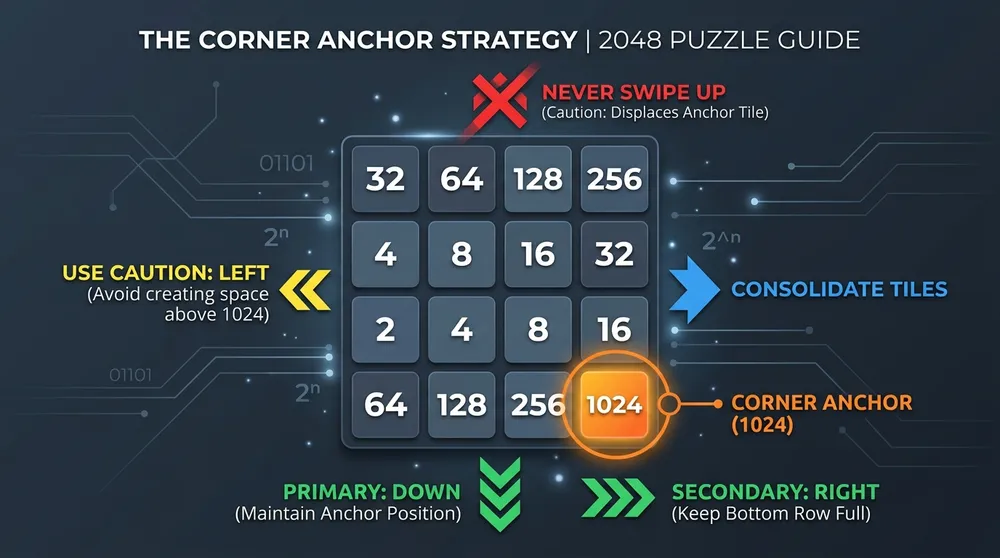
1. Corner Anchor: Locking the highest-value tile into a single corner (such as bottom-right) cuts its open neighbors from four down to two. This shields your anchor from getting surrounded by small rogue numbers.
2. Monotonic Ordering: Arranging numbers in strictly descending chains along an S-shaped path. A bottom row reading 128, 256, 512, 1024 allows a cascading merge in a single move.
3. Empty Cell Maximization: Board survival correlates directly with open space. Running with fewer than three open cells leaves you exposed to bad spawns.
Playing 2048 trains forward mental simulation. You cannot move based on immediate gratification. Combining two 4s on the top row is useless if it shifts your 1024 anchor out of its protected corner. You learn to suppress impulsive moves in favor of long-term spatial stability.
Minesweeper: Boolean Satisfiability and Deductive Proofs
Minesweeper strips away luck in favor of pure propositional logic. The game presents an unrevealed grid hiding a set number of mines. Opening a cell reveals either a blank space, an integer from 1 to 8, or a mine that ends the game.
The Linear Algebra of Cell Clues
Every revealed number establishes a strict linear equation:
$$\sum_{k \in \text{Neighbors}(i, j)} M_k = C(i, j)$$
Where $M_k \in \{0, 1\}$ is the presence of a mine in adjacent unopened cell $k$, and $C(i, j)$ is the clue value.
In 2000, mathematician Richard Kaye proved that Minesweeper is NP-complete. No computational shortcut solves every board instantly. Players must evaluate overlapping constraint equations across intersecting rows and columns.

Spatial Deduction Over Isolated Guessing
Minesweeper trains direct Boolean reduction:
This trains the brain in deductive verification. You look at an unrevealed sector, identify overlapping variable sets, and isolate confirmed truths without taking speculative gambles.
When the board produces an unavoidable 50/50 split, Minesweeper trains probabilistic triage. You compare local mine odds against the global remaining mine density ($P_{\text{global}} = \text{Mines Remaining} / \text{Unrevealed Cells}$). If the global density is 18% and your local border offers a 50% coin flip, logic dictates clicking a blind cell in an untouched quadrant over gambling on the local wall.
Ludo: Combinatorial Risk Hedging and Fleet Coordination
Ludo stems from the sixth-century Indian game Pachisi. Casual players dismiss it as mindless dice rolling. Expert players treat it as an optimization problem in statistical risk mitigation and tempo management.
The Mathematics of the 52-Square Circuit
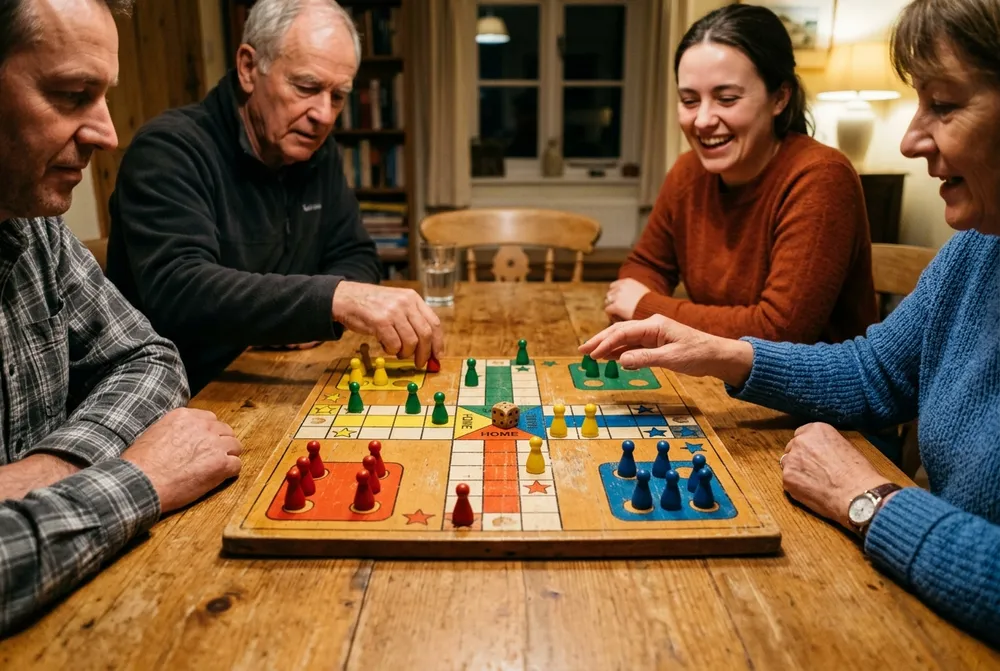
The board consists of a shared perimeter of 52 track squares, four colored starting yards, eight safe star squares, and four private home corridors. Every player commands four pawns.
A standard six-sided die controls movement. The baseline probability of rolling any specific face on a single die is:
$$P(N) = \frac{1}{6} \approx 16.67\%$$
Pawns remain locked in the starting yard until you roll a six. The probability of going $T$ turns without rolling a single six decays exponentially:
$$P(\text{Trapped over } T \text{ turns}) = \left(\frac{5}{6}\right)^T$$
By turn four, you have a 51.77% chance of rolling at least one six. By turn ten, the odds of remaining stuck fall to 16.15%.
Fleet Allocation vs. Single-Pawn Tunneling
Amateur players rush one pawn forward while three others rot in the yard. This creates extreme vulnerability:
Expert Ludo trains multi-agent fleet management. You coordinate four pawns separated by five to eight squares across the board. If an opponent sits within six squares behind pawn A, you leave pawn A on a safe star square and advance pawn B or C instead.
You learn to evaluate relative distances. An enemy pawn sitting seven squares behind you has a 0% single-roll capture probability; they must roll a six followed by a one ($P = 1/36 \approx 2.78\%$). Holding that seven-square cushion cuts your capture risk from nearly 17% down to under 3%.
Go Fish: Working Memory Capacity and Adversarial Inference
Go Fish is often taught to children as a basic matching game. Played among serious adults, it transforms into an exercise in mental ledger tracking and Bayesian deduction.
The Imperfect-Information Mental Ledger
Go Fish uses a standard 52-card deck. Players hold varying hand sizes and seek to compile four-of-a-kind sets (books).
Unlike 2048 or Minesweeper, Go Fish features imperfect information: you cannot see your opponents' cards. You must reconstruct the distribution of hidden ranks purely through acoustic and behavioral cues:
1. Direct Inquiry: Player A asks Player B for Kings. You learn two facts: Player A holds at least one King, and Player B either surrenders Kings or tells Player A to fish.
2. Negative Confirmation: If Player B says "Go Fish," you confirm that Player B holds zero Kings.
3. Transit Tracking: If Player C later asks Player A for Kings and receives them, the Kings move from Player A to Player C. You must erase Player A's ownership and update Player C's ledger entry.
Expanding Working Memory Span
Casual players track only the cards currently in their own hands. Expert players track the location of all 13 card ranks across every player at the table.
This forces active cognitive updates:
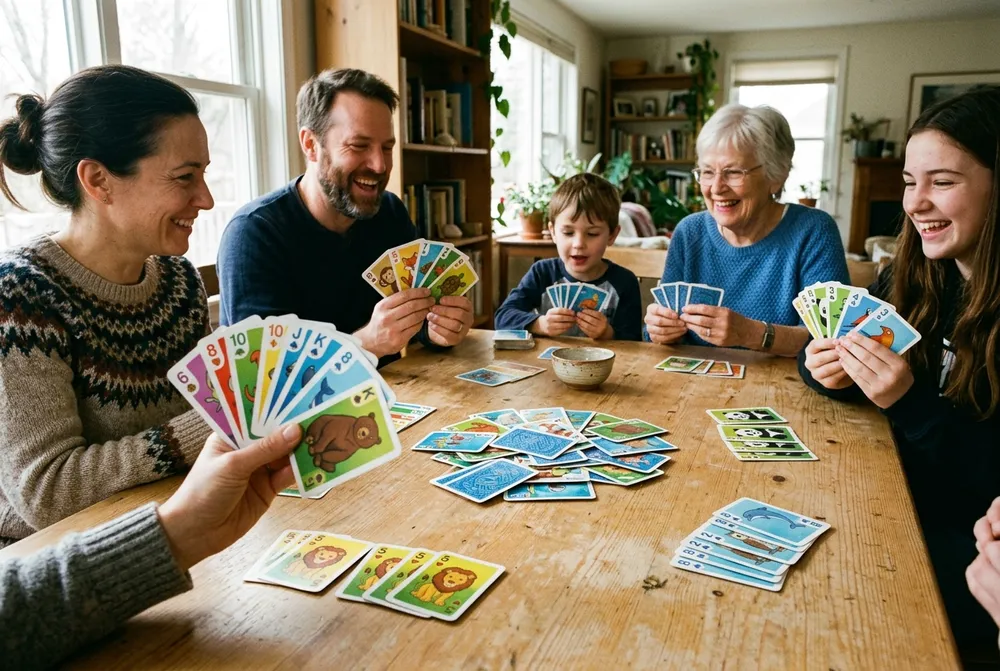
Go Fish also trains strategic inquiry timing. If you hold a single Queen, asking for Queens alerts opponents to your holding. If you know an opponent holds two Queens, asking immediately extracts them. If you suspect an opponent holds three Queens, asking transfers your lone card into their book, giving them the set. You must calculate hand compositions before making an inquiry.
Comparative Cognitive Matrix
Each game exercises a distinct subset of executive functions and mental calculations:
| Game | Primary Cognitive Domain | Key Brain Region | Core Computational Model | Error Consequence |
|---|---|---|---|---|
| 2048 | Spatial planning & monotonicity | Parietal lobe & prefrontal cortex | Expectimax tree search & entropy control | Gridlock and premature board death |
| Minesweeper | Deterministic Boolean deduction | Dorsolateral prefrontal cortex | Linear constraint satisfaction (NP-complete) | Instant game over on detonated mine |
| Ludo | Probabilistic risk mitigation | Frontal cortex & basal ganglia | Combinatorial pathfinding & tempo allocation | Loss of up to 50 squares of travel progress |
| Go Fish | Working memory & state tracking | Hippocampus & temporal lobes | Bayesian inference under hidden information | Hand leakage and surrendered books |
Designing a Daily 20-Minute Cognitive Routine
You do not need hours of dedicated puzzle sessions to build mental sharpness. A disciplined daily rotation sharpens reasoning through progressive variety:
1. Minutes 1 to 5: Spatial Order in 2048. Play one deliberate run of 2048. Enforce a strict one-second delay before every swipe. Lock your anchor to the bottom-right corner and build a clean monotonic chain. This wakes up spatial visualization and suppresses impulsive motor responses.
2. Minutes 6 to 12: Constraint Deduction in Minesweeper. Clear two Intermediate boards or work through an Expert grid. Ban random guessing. Force yourself to find logical proofs for every cell opening. When faced with a 50/50 trap, evaluate clock equity and make an immediate decision without stalling.
3. Minutes 13 to 20: Probabilistic Management in Ludo or Go Fish. Play a four-player match of Ludo or a hand of Go Fish. In Ludo, focus on four-pawn fleet spacing and star square camping. In Go Fish, maintain an unwritten mental ledger of every requested rank.
Frequently Asked Questions
Clinical studies indicate that engaging in intellectually demanding tasks builds cognitive reserve: the brain's resilience against neuropathological damage. While casual puzzles do not guarantee immunity against neurological diseases, regular mental workouts enhance processing speed, working memory maintenance, and executive function throughout adult life.
Download Free Shikaku Logic Puzzle Student Worksheet & Rules (PDF)
Save a copy to your computer or print for your classroom or game club.

Game developer and founder at Unicorn Games. Specializes in combinatorial game theory, solvability algorithms, and classic card & puzzle game development. Every guide is fact-checked against mathematical game states and empirical play benchmarks.